
Nelle sue opere mescola tradizioni e mito, per sfidare le narrazioni egemoni: chi è Gaelle Choisne, vincitrice del Prix Marcel Duchamp 2024
Continua — Weiterlesen www.exibart.com/arte-contemporanea/prix-marcel-duchamp-2024-a-gaelle-choisne-unarte-immaginativa-contro-lautorita/
Prix Marcel Duchamp 2024 to Gaelle Choisne: Imaginative Art Against Authority
CONTEMPORARY ART
by Elisabetta Pagella
Born in 1985, this artist blends Creole traditions, myth, and popular culture in her impactful installations to challenge dominant narratives. Who is Gaelle Choisne, the winner of the prestigious Prix Marcel Duchamp 2024?
On the evening of Monday, October 14, at the Centre Pompidou in Paris, the winner of the 24th edition of the Prix Marcel Duchamp, one of the most prestigious contemporary art awards in the world, was announced: Gaëlle Choisne. The award ceremony was opened by the museum’s president, Laurent Le Bon, along with Claude Bonnin, president of ADIAF – the Association for the International Diffusion of French Art, which organizes the prize – and the museum’s director, Xavier Rey, who made the official announcement. Choisne will receive a grant of 35,000 euros, a sum awarded since 2000 to an artist working in all fields of plastic and visual arts to encourage the development of diverse artistic research.
This edition, which like every year celebrates the most active and influential artists on the French contemporary scene, revolves around the theme of the “cosmic,” understood according to the ancient Greek conception of a return to order. Faced with the chaos of the universe and the disconnect that still exists between it and human understanding, the works draw from science, astrology, and myth to offer a broader vision, as if in an astronomical observatory where one has the sensation of exploring the unknown.
The winner was chosen by an exceptional jury of nine commissioners. Unlike in previous years, the board included two artists, Thomas Hirschhorn and Otobong Nkanga, alongside Claude Bonnin, collectors Estelle Francès and Alain Servais, the director of the Dijon Museum, Frédérique Goerig-Hergott, MoMA director Glenn D. Lowry – who will step down in 2025 – and Akemi Shiraha, representing the Marcel Duchamp Association.
Prix Marcel Duchamp 2024: Gaëlle Choisne’s Work
Gaëlle Choisne was born in 1985 in Cherbourg, France, to a Haitian mother and Breton father. Her work is based on research into political and cultural disorders, whether caused by the exploitation of nature and its resources or the remnants of colonial history. In her opulent installations, she mixes “esoteric Creole traditions, myth, and popular culture.”
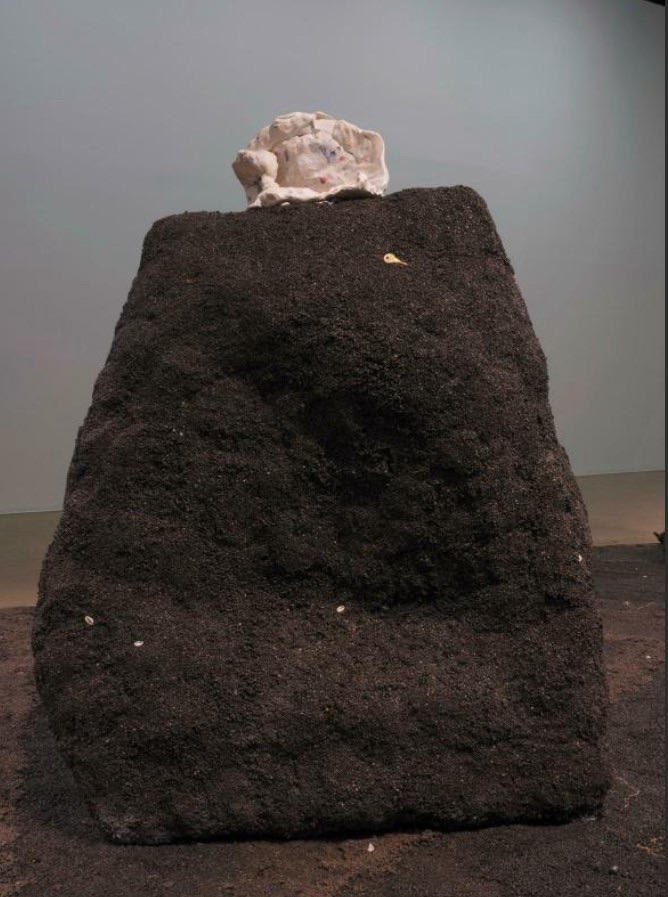
The main work presented at the exhibition is titled Safe Space for a Passing History – Era of Aquarius 99999, referencing the astrological movement of Aquarius, symbolizing a new era that will change history. Imagination thus becomes the tool to oppose the “materialistic and authoritarian” Western vision of the world.
At the heart of the scene, the viewer walks across an uneven, clay-like terrain, compact but rubbery: the foot presses and lightly rebounds while one pauses to gaze at precious objects like gold chains, coins, gemstones, keys, and other materials embedded in the surface of the work. Five pedestals hold small, roughly made ceramics on which different videos are projected. The back wall contains a heterogeneous mix of techniques and materials, acting as deconstructive elements of Western culture. Scarp paintings, which are assemblages of images, paintings, and objects, emphasize the driving force of the project: hospitality and unconditional exchange between people. The mixture of styles metaphorically becomes an opening to the other, as well as the possibility for the spectator to walk and interact with the artwork.
Who Are the Other Finalists Exhibited at the Centre Pompidou?
The other three finalists for the Prix Marcel Duchamp 2024 are Abdelkader Benchamma, the duo Angela Detanico and Rafael Lain, and Noémie Goudal.
Abdelkader Benchamma, born in Mazamet, France, in 1975 to Algerian parents, lives and works between Paris and Montpellier. His preferred medium is black-and-white drawing, conceived not as a physical object but as a means to create immersive works. His studies draw from literature, philosophy, and astrophysics, with the aim of crossing the boundaries of tangible reality.
The drawings he presents at the Pompidou seem to escape the viewer’s eye, as they are not constrained by any frame and barely stay confined to the walls. In his work At the Edge of Worlds, he references the title of a book by Mohamed Amer Meziane, inviting the viewer to push the limits of the visible. Almost like a nebula moving through space, the work searches for the invisible, collective memory, through traces and traditions of places in a decolonial perspective.
Angela Detanico and Rafael Lain, born in 1974 and 1973 respectively, hail from Caxias do Sul, Brazil. They live and work in Paris. Their research focuses on creating installations that combine text, drawing, video, and image. For over 20 years, they have studied a system of signs and symbols to make cosmic and cosmological phenomena comprehensible. Their goal is to subvert the pre-established codes of contemporary communication, translating words or concepts from other systems of readability into a new visual language.
Thus, the mirrored stars forming the constellation of Eridanus spread throughout the exhibition space, forming new evocative and open symbols: in the night of the time, light flourishes, the first stars blossom, messages from distant times. The double projection Flowering of Light offers a dual vision of the universe, juxtaposing micro and macro cosmos: a field of flowers grazes the edge of deep space, images of sections of sky millions of light-years from Earth. The initial sense of disorientation fades with the resemblance between two materially distant but visually close worlds.
Noémie Goudal, born in Paris in 1984, works with video and photography to depict “deep time,” the geological history of the planet. She is inspired by science, particularly paleoclimatology, the study of climate conditions in past geological eras. Photography becomes the medium through which Goudal reconstructs these events. She stages physical phenomena and the passage of time, offering a narrative “of the extinction and rebirth of the world.”
Her installation opens in a dark room. Light comes from two vertical videos placed in opposite corners. A primitive cave, Grand Vide (Great Void), explodes before the viewer, but it is not the stone that shatters; it is the scenery. This cave is made of stage layers that fall away, revealing the strings of these telluric puppets. Opposite, a geological landscape, Supra Strata, features a forest with a central water source. The water seems to erode the landscape, but it is not the greenery that wilts; it is the image representing it.
 piWerk